


A car accident sets off a chain of events that doesn’t stop once you leave the scene. Medical appointments pile up, bills start arriving, and calls from the insurance company come in before you’ve had time to process what happened. If Allstate is involved, whether as your own insurer or the other driver’s, you’re dealing with one of the country’s largest auto insurers, and the Allstate accident claim process doesn’t always move in your favor.
Filing the claim is only part of the picture. What happens after you file, how Allstate evaluates your injuries, what the company offers, and how it handles disputes, can have a far greater impact on your financial compensation than the initial report. Washington State law recognizes specific rights in this process that can directly affect how your claim plays out.
At a Glance

- Filing an Allstate accident claim involves notifying the company, submitting documentation, and working through the claims investigation process
- Your claim may include compensation for medical bills, lost wages, property damage, and non-economic damages
- Allstate uses proprietary Colossus software to calculate settlement values, which often produces offers lower than what your claim is worth
- The insurance company will investigate liability and may attempt to reduce what it pays by disputing your injuries or assigning you a percentage of fault
- A denied insurance claim is not final, and you have the right to appeal and to pursue legal action
- Washington State law provides multiple protections, including the Consumer Protection Act and the Insurance Fair Conduct Act
- An attorney can step in to negotiate with Allstate, submit a demand letter, or file a lawsuit on your behalf
What an Allstate Accident Claim Covers
An Allstate accident claim is the formal process of requesting payment under an insurance policy after a car accident. Depending on how the crash happened and what coverage is in play, you may be filing with your own insurer, the at-fault driver’s insurance company, or both.
A properly prepared claim can include compensation for:
- Medical bills: emergency treatment, hospital stays, follow-up care, physical therapy, prescriptions, and future medical care tied to your injuries
- Lost wages: income you missed while recovering from your injuries, including time off work for medical appointments
- Property damage: vehicle repair or replacement and any personal property damaged in the accident
- Non-economic damages: pain and suffering, emotional distress, and loss of enjoyment of life
- Wrongful death claims: if a family member was killed in the car crash, a claim may be filed on their behalf
Washington State law governs how Allstate evaluates fault and calculates what it owes. Under comparative fault rules, your potential compensation may be reduced by your percentage of responsibility for the accident, but you may still be eligible to recover compensation even if you were partially at fault. Liability is one of the most disputed elements in any car accident claim, which is why how your claim is documented from the start carries real weight.

Before You File: What to Pull Together
The window to build a strong claim is open right now, but it won’t stay open indefinitely. The documentation you gather in the days following a car crash directly affects what Allstate will have to work with when it investigates.
Start by pulling together:
- The police report: If one was filed at the scene, obtain a copy as soon as it’s available and review it carefully. Errors can be challenged, but they need to be addressed early.
- Photos and visual evidence: Images of the vehicles, the road, and the surrounding area help establish what happened and where.
- Witness statements: If you have contact information for anyone who saw the accident, their account can support your version of events.
- Medical records and bills: Keep a complete record of each appointment, each diagnosis, and each bill, along with each prescription, each referral, and any time you miss work because of your injuries. If your injuries are severe, these records become the core of your claim for both economic and non-economic damages.
If Allstate contacts you and requests a recorded statement, you’re not required to provide one immediately. A recorded statement can be used to challenge your claim later. Stick to the factual basics, don’t admit fault, and don’t sign anything without attorney review.
How the Allstate Accident Claim Process Works
Filing an Allstate accident claim involves several connected steps. Each one builds on the last, and how you handle each affects the overall value of your claim.
Step 1: Notify Allstate
Contact Allstate through their 24/7 claims line, their mobile app, their online portal, or through your local agent to report the accident. Provide the date, location, vehicles involved, and a basic factual account of what happened. Keep your description factual and brief. Avoid speculation about fault, and don’t downplay your injuries.
Step 2: Submit Your Documentation
Once the claim is open, Allstate will request supporting materials. This is where your preparation pays off. You’ll typically need to provide the police report, photos and other documentation from the scene, medical records and bills for your injuries, witness statements, and vehicle repair estimates.
The more complete and organized your documentation, the less room Allstate has to dispute the scope of your injuries or the circumstances of the accident. Insufficient evidence is one of the most common reasons Allstate uses to delay or deny a claim, so document everything.
Step 3: The Claims Adjuster Investigation
A claims adjuster will be assigned to investigate your Allstate accident claim. The adjuster’s job is to evaluate liability, assess your injuries, review property damage, and determine what the company believes the claim is worth. This part of the process often involves requests for additional records, follow-up questions, and back-and-forth communication that can stretch the timeline considerably.
Keep in mind what the adjuster’s role actually is: They work for Allstate, not for you. Their evaluation is shaped by what the insurance company wants to pay, not necessarily what your injuries and losses are worth.
Step 4: The Settlement Offer
After reviewing your claim, Allstate will issue a settlement offer. That number reflects their assessment of your economic damages, including medical bills, lost wages, and property damage, along with their calculation of non-economic damages based on the severity of your injuries.
Initial offers are routinely lower than what the claim may actually be worth, particularly for serious injuries with long-term consequences. Allstate uses a proprietary software program called Colossus to calculate settlement values. The program analyzes medical records, property damage, and lost wages to generate a number, but it works from generalized guidelines rather than your specific situation. That built-in limitation routinely produces valuations that fall short of what an injured person’s claim is actually worth.
Step 5: Negotiation, Demand Letter, or Legal Action
If the offer doesn’t reflect your actual losses, you have options. You can negotiate directly with Allstate, or your attorney can submit a demand letter laying out the full scope of your damages and the legal basis for a higher number. If Allstate won’t move, filing a lawsuit may be the appropriate path. In some cases, a lawsuit is the only path that can produce a fair compensation decision.
When Allstate Disputes, Delays, or Denies Your Claim
Not every Allstate accident claim moves cleanly through the claims process. The insurance industry is structured to manage risk and control payouts, which means disputes are common, and some are manufactured.
Low Settlement Offers
A low offer isn’t just frustrating; it’s a negotiating position. When Allstate denies or minimizes non-economic damages, it’s often by arguing your injuries aren’t as severe as documented, or by disputing how certain injuries are connected to the car accident. Fight the urge to accept the first offer. It rarely reflects what your claim is actually worth and the extent of covered losses you may be eligible to recover.
Delays in Processing
Some claims take weeks. Others take months. Delays often occur when liability is disputed, when additional documentation is requested, or when the company uses the passage of time as leverage against an injured person who needs to pay medical bills and property repairs now. Dealing with repeated delays is one of the most frustrating aspects of an insurance dispute, and it’s often intentional.
Insurance Claim Denied
If your Allstate claim was denied, what to do next starts with understanding your right to appeal. There are common reasons Allstate denies claims, and knowing them can help you respond effectively. A denied insurance claim can happen due to:
- Disputed fault or liability
- Alleged policy exclusions
- Claims that injuries were pre-existing and unrelated to the accident
- Insufficient evidence or missing documentation
- Assertions that you admitted fault or misrepresented the accident
When Allstate denies your accident claim, that’s not the end of the road. Carefully review the denial letter. Allstate is required to provide a detailed explanation of why your claim was denied. You have the right to appeal, and in Washington State, you have the right to legal representation throughout that process.
Disputes Over Injuries
Allstate may argue that your injuries were pre-existing, that they’re unrelated to the car crashes it covers, or that the treatment you received was excessive. These insurance disputes are common in cases involving soft tissue injuries, delayed-onset conditions, or continuing care for severe injuries.
Medical documentation and the timeline between the accident and your diagnosis both matter here. The stronger your evidence, the harder it is for Allstate to deny or minimize the full value of your claim.
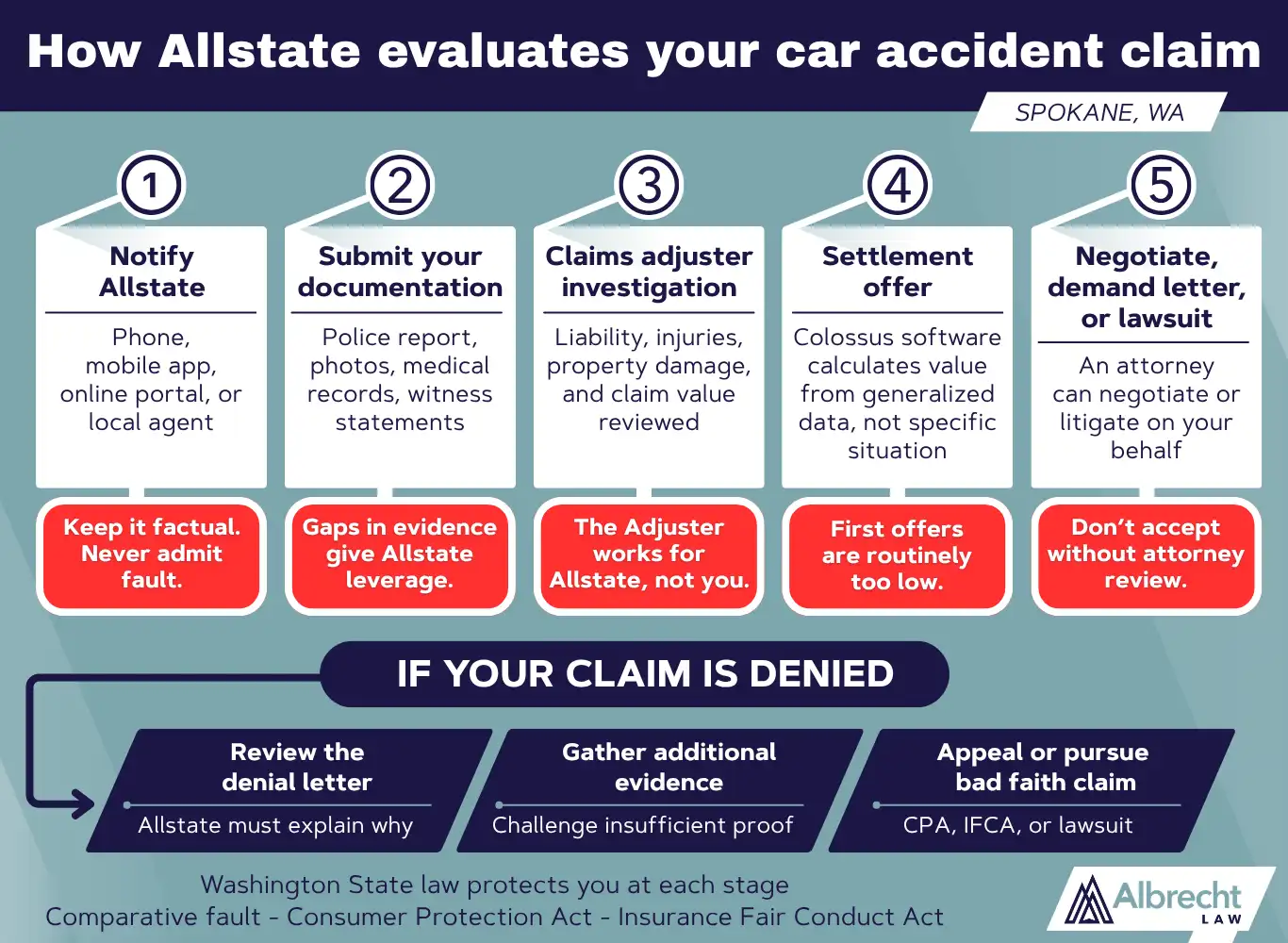
The infographic below shows how the Allstate accident claim process typically unfolds and where things commonly go wrong.
Bad Faith Insurance Claims: When Allstate Crosses a Line
There’s a difference between Allstate negotiating hard and Allstate acting in bad faith. Washington State insurance law defines exactly where that line falls. Allstate denying claims in bad faith is not simply aggressive negotiating. It’s a violation of your rights under Washington law. A bad faith insurance claim may arise when Allstate:
- Unreasonably delays when you should receive payment without a valid reason
- Fails to conduct a proper investigation of your injuries or the accident
- Misrepresents the terms of your insurance policy or its fine print
- Refuses to pay a valid claim or denies it without a legitimate basis
- Uses tactics designed to pressure you into accepting less than what is available under the law
Washington State gives injured people meaningful tools to fight back through multiple overlapping laws.
The Washington Consumer Protection Act (CPA)
The Consumer Protection Act prohibits unfair or deceptive acts in commerce, and that includes insurance. A bad faith insurance claim brought under the CPA can seek the full value of your original claim, attorneys’ fees and legal costs, and treble damages of up to $25,000 when the insurance company’s conduct caused actual losses. It’s designed to hold insurers accountable when they treat policyholders as obstacles rather than people with valid claims.
The Insurance Fair Conduct Act (IFCA)
Washington’s Insurance Fair Conduct Act gives policyholders the right to file notice of a potential lawsuit when they believe their insurer is acting in bad faith. The IFCA provides an additional path to compensation beyond what’s available under the CPA and common law.
Common Law Bad Faith
Separate from the CPA and IFCA, Washington recognizes common law bad faith claims. An attorney can pursue all three simultaneously if the facts support it.
Recognizing bad faith early changes how your case should be handled. If you believe Allstate is acting in bad faith, the steps you take and the documentation you preserve become critical to a future claim for enhanced damages.

How Washington State Law Affects Your Allstate Claim
Washington is a fault-based state, meaning the at-fault driver and their insurer bear financial responsibility for injuries and losses caused by the accident. Under Washington’s comparative fault system, you can be eligible to recover compensation even when you share some responsibility, but your recovery would be reduced by your percentage of fault.
For example, if your total damages are $100,000 and you’re found 20 percent at fault, you’d recover $80,000. This is why Allstate has a direct financial incentive to argue that you contributed to the accident. The more fault the company can assign to you, the less it owes.
Washington insurance law also requires insurers to handle claims in good faith and in accordance with the state’s fair claims settlement practices. The Washington State Office of the Insurance Commissioner oversees insurer conduct, and policyholders have the right to file a complaint when a company violates those standards.
What Your Claim Should Include
A complete Allstate accident claim accounts for all categories of damages, not just the ones that are easy to document.
Economic damages are the measurable financial losses tied to the accident. These include medical bills for treatment you’ve already received, the cost of future medical care if your injuries require ongoing attention, lost wages from time away from work, and property damage to your car and any personal items.
Non-economic damages cover what can’t be reduced to a receipt. Pain and suffering, emotional distress, anxiety, and the loss of activities you could enjoy before the accident all fall into this category. These are often where Allstate’s initial offers fall furthest short of what the claim is actually worth, particularly in cases involving severe injuries, long recovery periods, or permanent limitations.
In wrongful death cases, the claim extends to a family member’s medical expenses, lost future income, and the loss of companionship and support they would have provided.
When to Bring in a Spokane Car Accident Attorney

Some Allstate accident claims resolve without a dispute. Many don’t. You should strongly consider speaking with a Spokane car accident lawyer if:
- Your injuries are severe or require ongoing medical care
- Allstate has denied your insurance claim
- The settlement offer doesn’t come close to covering your medical bills and lost wages
- Fault is disputed and Allstate is assigning you a percentage of responsibility
- You believe the company is acting in bad faith
- The accident involved multiple parties or complex insurance coverage questions
- A family member was killed in the car crash
An attorney can investigate the accident independently, gather evidence, review your insurance policy, prepare and submit a demand letter, negotiate with Allstate on your behalf, and file a lawsuit if the situation warrants it. Personal injury attorneys who handle insurance disputes know how Allstate and other insurers operate, and they know what a fair claim looks like under Washington law.
Allstate knows that a represented client has access to legal tools the company would rather not face, including bad faith claims, CPA treble damages, and litigation.

Frequently Asked Questions
How long does an Allstate accident claim take?
The timeline depends on the complexity of the claim. Straightforward claims may resolve in weeks. Claims involving severe injuries, disputed liability, or bad faith conduct can take months or longer. An attorney can keep the process moving and flag unnecessary delays.
Can Allstate deny my car accident claim?
Yes. Insurance claim denials happen for a variety of reasons, including disputed fault, alleged policy exclusions, pre-existing injury arguments, and documentation issues. A denied insurance claim is not final. You have the right to appeal and to pursue legal action if the denial was improper.
Do I have to give Allstate a recorded statement?
You may be asked for one, but you’re not required to provide a recorded statement right away. What you say can be used to challenge your claim or to argue that you admitted fault. Speak with an attorney before agreeing to a recorded interview with the insurance company.
What if Allstate’s offer is too low?
The solution to a lowball offer is to negotiate. A demand letter outlining the full value of your damages, including medical bills, lost wages, pain and suffering, and future medical care, is often an effective next step. If Allstate won’t respond reasonably, a lawsuit may be necessary.
Can I still recover compensation if I was partially at fault?
Yes. Washington’s comparative fault system allows you to recover compensation as long as you weren’t solely responsible. Your recovery is reduced proportionally by your percentage of fault.
What is a bad faith insurance claim in Washington?
A bad faith insurance claim arises when an insurer fails to handle your claim fairly and in accordance with its legal obligations under Washington insurance law. Remedies include the full value of your original claim, legal costs, and potentially treble damages under the Consumer Protection Act.
Albrecht Law PLLC: Spokane’s Insurance Dispute and Car Accident Lawyers
When Allstate is managing your car accident claim, the pressure to accept a quick settlement can feel intense, especially when medical bills are mounting and you’ve already missed work. What Allstate offers early in the process rarely reflects the full value of your injuries, your financial losses, or your rights under Washington State law.
At Albrecht Law PLLC, the personal injury attorneys and insurance dispute attorneys in Spokane, WA know how Allstate and other insurers operate. When insurers act in bad faith, Albrecht Law aggressively advocates for its clients, pursuing each available path to recover compensation, including CPA bad faith claims and IFCA remedies. There is no fee unless a recovery is made. That approach is grounded in the firm’s work authoring the Washington Legal Reference Guides, cited by the Washington State Court of Appeals and Supreme Court.
Your free consultation is confidential and available now. During that conversation, you can ask about your insurance claim, your medical bills and lost wages, how comparative fault applies to your situation, and what happens if your claim has already been denied or undervalued.
Albrecht Law PLLC represents injured clients throughout Spokane County, Spokane Valley, and across Eastern Washington, with individualized attention and careful preparation at each stage of the claim. Founding Attorney Matt Albrecht has argued cases before the Washington State Supreme Court, and that appellate background shapes the strategy used in each case, whether that means negotiating with Allstate or preparing for litigation.
Call (509) 495-1246(509) 495-1246 to schedule your free consultation with a Spokane car accident lawyer. You can also connect through the confidential online form on the website.
Albrecht Law PLLC – Our Clients Are More Than Just Cases
Copyright © 2026. Albrecht Law PLLC. All rights reserved.
The information in this blog post (“post”) is provided for general informational purposes only and may not reflect the current law in your jurisdiction. No information in this post should be construed as legal advice from the individual author or the law firm, nor is it intended to be a substitute for legal counsel on any subject matter. No reader of this post should act or refrain from acting based on any information included in or accessible through this post without seeking the appropriate legal or other professional advice on the particular facts and circumstances at issue from a lawyer licensed in the recipient’s state, country, or other appropriate licensing jurisdiction.
Albrecht Law PLLC
5105 E. 3rd Avenue, Suite 101
Spokane Valley, WA 99212
(509) 495-1246(509) 495-1246
https://albrechtlawfirm.com/
Schedule A Free
Consultation Today
No Fee Unless You Win
Call (509) 495-1246(509) 495-1246, or fill out the short form. Don’t hesitate, your questions are welcome.
Required Fields*
Your Information Is Safe With Us
For more information on how your data will be handled, Please Visit Privacy Policy. The information you provide will be used to answer your question or to schedule an appointment if requested.
Related Blog Posts
Auto Accident Settlement Timeline in Spokane, Washington: What You Need to Know
A serious car accident in Spokane rarely feels like a one-day event. The crash is over in seconds, but the impact lingers weeks or months later when you’re still dealing…

How Long Does Whiplash Last After a Car Accident in Spokane, Washington?
You may have walked away from a car accident thinking you escaped without a serious injury, only to wake up the next day with neck pain and stiffness. The sudden…

Should I Get a Lawyer for a Minor Car Accident in Spokane, Washington?
The damage looks minor. You exchanged insurance information, took a few photos, and drove away. No ambulance, no drama. So why does something feel off? The stiffness in your neck…

Is Lyft Safer Than Uber in Spokane, Washington?
When a rideshare trip ends in a collision, many Spokane riders replay the moment and wonder whether choosing a different service could have changed the outcome. Residents rely on Uber…